




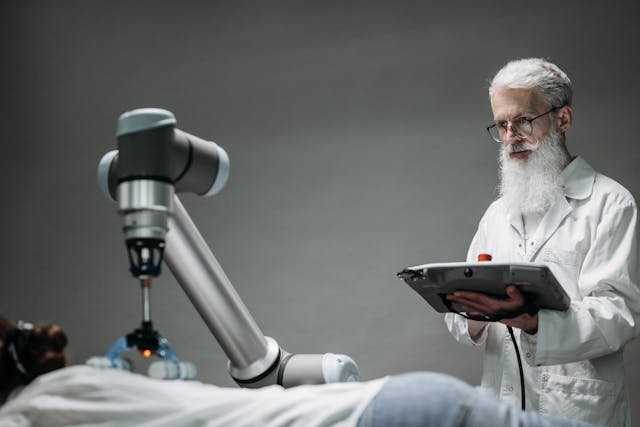
The healthcare business is undergoing a radical shift. The use of artificial intelligence (AI) and automation is not a concept of the future anymore; it is a force changing the way care is provided, operations are performed, and the interaction between patients and providers. From diagnosis to data management, every touchpoint in healthcare is being enhanced through intelligent technology and healthcare software development services that tailor AI-driven systems to the unique needs of hospitals, clinics, and research centers.
The Collusion of AI and Automation in Healthcare
Historically, healthcare has been held back by administrative burdens, manual entry of data, twin systems, and inefficiencies. Automation has resulted in significant enhancements: electronic health records (EHRs), digital scheduling, automated billing, etc., but currently, AI is adding to the already existing automation, enabling it to learn, predict, and adapt. Healthcare is, in a way, transitioning to smart workflows as opposed to rule-based workflows.
Consider two key shifts:
- Automation eliminates manual and repetitive work, data entry, claims processing, appointment reminders, and supply-chain monitoring.
- Decision-making support, pattern recognition (in data, in images), predictive analytics, and personalized care have been introduced by AI.
The two of them not only transform the way things are done, but also what is possible.
Clinical Care: Wiser, Faster, Accurate
Among the most evident effects are the diagnostics and treatment. Imaging (MRI, CT scans, X-rays) can be analyzed by AI algorithms to detect anomalies, in some cases, unnoticed by human eyes. With automation, once a routine finding is noted, the system can issue workflows automatically, i.e., notifying the care team, scheduling follow-up, and linking to the patient record.
In addition to diagnostics, AI and automation also contribute to personalized medicine. As an illustration, using the genetic, lifestyle, and clinical information of a patient to propose individualized treatment or prevention strategies. Then, automation makes sure that the care course is adhered to: alerts are sent, information is monitored, and exceptions are detected.
The outcome: more rapid diagnoses, decreased mistakes, more proactive interventions, and the transition of reactive care to preventive and personalized care.
Operational Excellence: Back-End to Front-End Efficacy
Operational systems are highly strained in the healthcare delivery. As AI and automation meet, the field of internal processes is undergoing significant upgrades: inventory control, scheduling of facilities, staff shifts, logistics of supply chains, and so on.
For instance:
- The pharmaceutical supply chain is automated to handle the entire supply chain, including the use of pharmaceuticals, anticipated shortages, and the generation of reorders.
- The AI models predict patient admissions so that hospitals can be dynamically staffed and bed capacity can be determined.
- Check-in and patient triage processes are managed automatically, as well as a post-discharge follow-up, allowing staff to be redirected to other, more complex areas.
Through the automation of processes and the minimization of human labor, healthcare organizations will reduce costs, improve throughput, and allocate resources to the areas where they are most needed.
Patient Engagement and Experience: Beyond Passive to Active
Patients are not satisfied with the ordinary treatment anymore; they want an experience, a personalized and connected experience. That is possible through AI and automation. VHA is able to understand the queries provided by the patient in a natural language, make appointments, remind of medications, and escalate when necessary. They interact with the patients around the clock, releasing human resources.
On the one hand, automation is used to ensure the presence of follow-ups, the collection and action of wearables data, and the integration of tele-health visits with records. Such an approach would assist in transforming passive patients into active participants in the health process.
Statistics and Vision: The Fuel to the Future
Data is at the core of automation and AI. EHR, imaging, devices, wearables, and patient engagement system data are becoming vast datasets that are being aggregated and analyzed. AI is preying on this, deriving insights: what treatments are effective, what efficiencies are missing, which patients are readmission-prone.
Automation makes these insights operationalized, i.e., reports delivered to the appropriate stakeholders, workflows initiated, and interventions automatically scheduled. The synergy enables healthcare organizations to switch between data collection and its application in real time.
Custom Software Role: It All Has to Work
A powerful, committed digital solution should be implemented in healthcare organizations to realize the transformation. It is there that healthcare software development services are.
Bespoke software is developed with the purpose of healthcare to provide a secure flow of data, systems integration (EHR, imaging, scheduling, billing), artificial intelligence modules, automation engines, all tailored to the requirements of the organization: compliance, size, security.
Through collaboration with an expert who has insight into the healthcare field, organizations will be able to implement solutions that not only cross the box but also provide tangible effects: improved diagnostics, easier work, and more data-driven decisions.
Challenges to Navigate
Naturally, the road does not run smoothly. Key challenges include:
- Quality and interoperability: A large number of institutions are faced with disjointed systems and data. Automation and AI should be based on clean, integrated data.
- Regulation, privacy, and ethics: The healthcare operations require adherence (HIPAA, GDPR, local regulations), responsibility, and transparency of AI decisions. These safeguards should not be undermined by automation.
- Adverse reaction to change: Employees might be afraid of automation taking their jobs; they might distrust AI. The adoption has to be accompanied by training, communication, and attention to change.
- Scalability and maintenance: AI models disillusion, automation processes become old-fashioned. In the absence of constant inspection, there is a loss of benefits. Organizations need to be designed to evolve continuously and not to be launched once.
The Future, Connected, Intelligent, Proactive Healthcare
The future has become a smarter ecosystem. Consider the scenario of a patient who has data on wearable devices entering an AI component, which predicts a heart aberration. The machine initiates a mechanized workflow to book a check-up, notifies the cardiology team, and channels the outcomes to the patient record, before the patient even makes the phone call.
Or a hospital with autonomous systems that do staff scheduling, facility usage, and supply-chain logistics so that clinical professionals no longer have to worry about any of that, and they can devote their full attention to care.
Healthcare in such a future will be:
- Proactive: Being able to anticipate problems and not react.
- Individualized: Care plans that are individualized in real time.
- Linked: Integrated devices, departments, and organizations.
- Efficient: Optimized resources, minimized waste, and increased access.
Final Thoughts
AI and automation cannot be considered auxiliary tools in healthcare, as they are transformational necessities. They transform not only the work of individuals but also the whole model of care, business structures, and relationships between providers and patients.
To those organizations willing to make this change, a decisive differentiator will be the decision to invest in bespoke digital solutions, via partners who provide custom services of creating software development solutions in specialized healthcare. When you are interested in better performance, higher efficiency of work, and meaningful interaction with patients, the moment has come to take action.
The digital healthcare future is only the intelligent part of the future and is autonomous and value-driven in real-time.